September 11 is a day we remember in many different ways. This year marks 25 years since we felt the tragic loss of so many lives, the families and communities forever changed, and the many people whose lives were shaped by what happened and in the years that followed.
At the National Museum of the Marine Corps, those memories are preserved through the experiences of Marines and through the aircraft, artifacts, and memorials that help tell the story of September 11 and its aftermath.
You don't have to travel to New York City or Washington, D.C., to find a meaningful place to remember. At the Museum, visitors can encounter firsthand artifacts from September 11 and learn how Marines responded, served, and carried the memory of that day with them.
A Flag That Survived
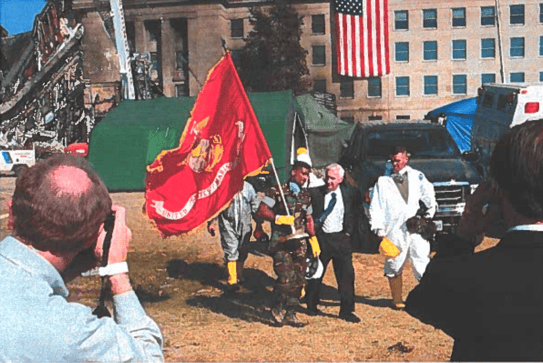
One of the Museum's most powerful 9/11 artifacts is a Marine Corps flag recovered from the Pentagon.
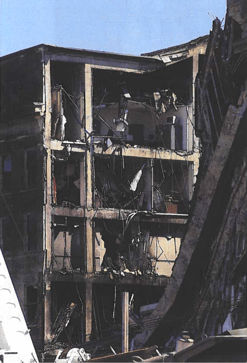
The flag stood in the office of the Counsel of the Commandant of the Marine Corps, just yards from where American Airlines Flight 77 struck the building. The destruction around it was immense. The building was severely damaged, objects throughout the area were destroyed, and the lives of those inside were forever changed.
Yet the flag remained standing.
It was not burned, torn or damaged. It survived the destruction around it almost untouched.
That contrast is part of what makes the flag so significant. Surrounded by destruction and loss, it remained standing—a powerful symbol of endurance and resilience. Today, the Museum preserves the flag as a reminder of what survived that day and of the stories that must continue to be remembered.
The Marines Who Took to the Skies
The Museum's F/A-18A Hornet, BuNo 161970, represents the Marine Corps' response in the immediate aftermath of the attacks.
The day after September 11, this aircraft flew its first armed combat air patrol mission over Washington, D.C. The Hornet offers a glimpse into the Marines who were called upon to help protect the nation's capital during a time of uncertainty.

The AH-1W Super Cobra offers another powerful reminder of those who served and sacrificed.
Its 9/11 markings honor the New York City firefighters who lost their lives at the World Trade Center. The markings began with Marines who carried the memory of those firefighters with them during deployments to Afghanistan and were retained as the aircraft moved between squadrons.
Together, these aircraft show that the story of September 11 did not end on September 11. The response continued, and so did the responsibility to remember.
Pieces of September 11
Some of the Museum's most meaningful reminders are pieces of the places themselves.
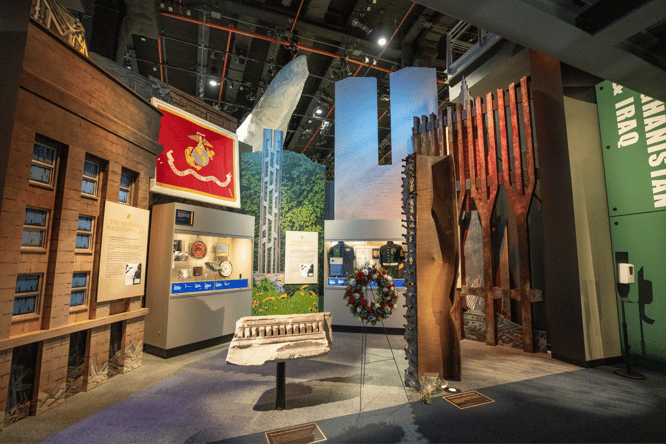
Visitors can see—and actually touch—a recovered I-beam from the World Trade Center and a fragment from the Pentagon. There is something powerful about being able to place your hand on a physical piece of a place that played such a significant role in September 11. These are not reproductions or representations. They are pieces of the buildings themselves that survived.
That experience is unique to being here. You can read about the World Trade Center and the Pentagon or see photographs of the buildings from anywhere. But standing in the Museum and touching the material that was there on September 11 creates a physical connection to history that photographs cannot provide.
Throughout the galleries, visitors will also find a collection of other artifacts recovered from the Pentagon and World Trade Center. Damaged signs, melted keys, and a clock stopped at the time of impact are just a few examples.
Each object offers a glimpse into the physical reality of that day, making September 11 tangible in a way that words alone cannot.
Remembering in Semper Fidelis Memorial Park
The story continues outside the Museum in Semper Fidelis Memorial Park.
Among the park's more than 44 memorials and plaques is the New York Fire Department 9/11 Memorial, honoring the 17 Marines who were among the fallen NYFD firefighters at the World Trade Center.
Two steel beams recovered from the World Trade Center form the centerpiece of the memorial. One bears the emblem of the New York City Fire Department, while the other carries the Marine Corps eagle, globe, and anchor. The names of each fallen firefighter are inscribed on the memorial.
The memorial offers a quiet place to pause and reflect, connecting the Marine Corps to the lives and sacrifices remembered there.


Remembering Through Resilience
Preserving the story of September 11 is about more than preserving the past. It is about ensuring its meaning continues to resonate with generations who did not experience it firsthand.
One Marine Corps Heritage Foundation employee reflected on the symbolism of the steel beams:
"They were strong enough to support buildings that once towered over New York City, only to fall because of an act of hatred. Afterward, they could have been destroyed, melted down, repurposed, or simply discarded. Instead, pieces of that steel were preserved and placed in memorials across America. What was intended to destroy our pride became a symbol of our resilience...uniting communities, honoring those we lost, and ensuring that we never forget."
That resilience is part of what the Museum has a responsibility to preserve. The flag that remained standing, the aircraft flown by Marines in the aftermath, the objects recovered from the Pentagon and World Trade Center, and the memorials throughout the Museum's grounds all help keep these stories alive.
Together, they remind us that September 11 is remembered not only through what was lost, but through what endured.
This September 11, visit the National Museum of the Marine Corps to remember, reflect, and experience these pieces of history for yourself.